The 14-Point Trap: Iran Is Negotiating to Keep Everything It Has
A framework for peace that leaves the nuclear program running and the Strait of Hormuz under IRGC supervision is not a framework for peace. It is a framework for the next war.
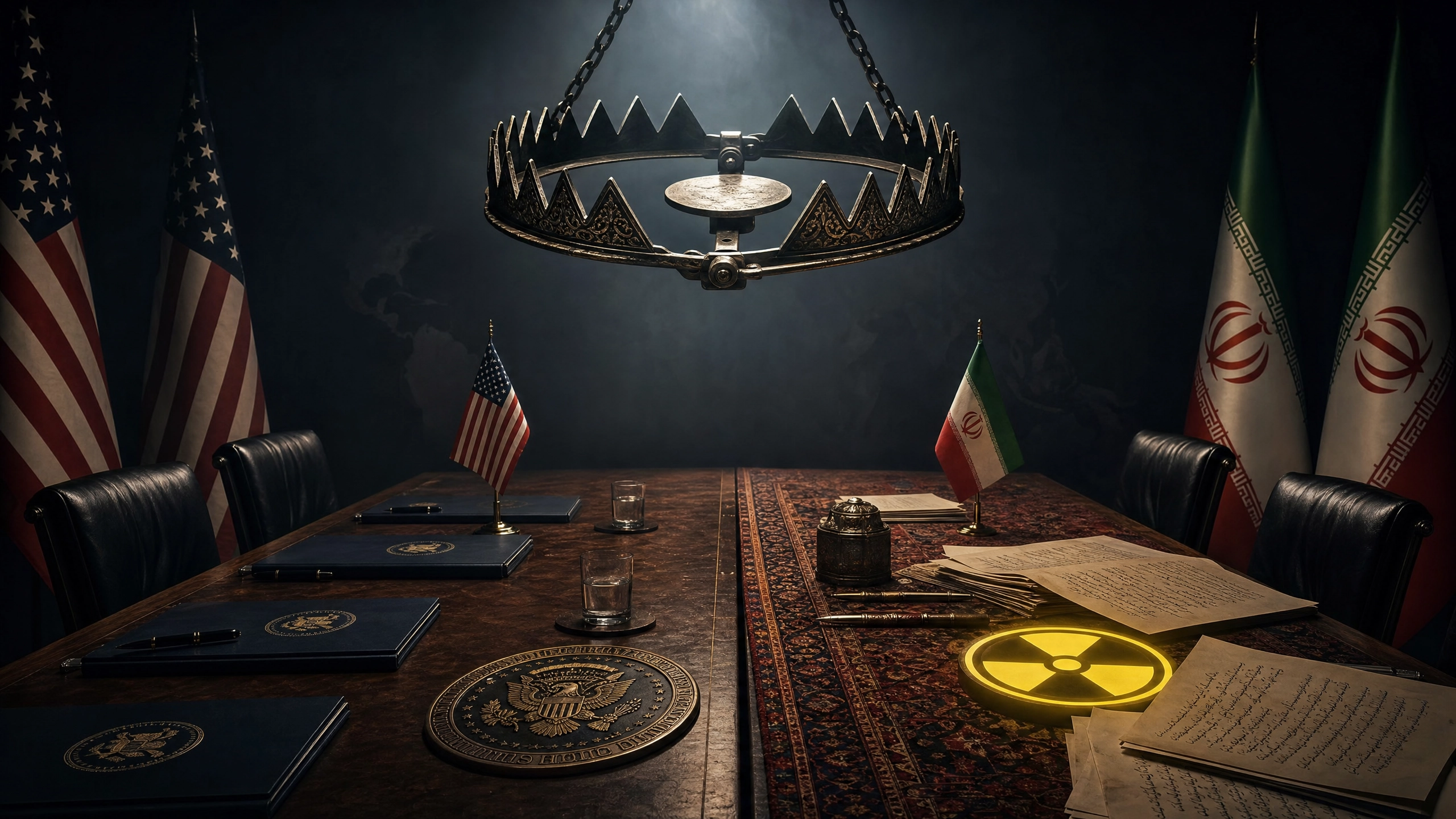
A framework for peace that leaves the nuclear program running and the Strait of Hormuz under IRGC supervision is not a framework for peace. It is a framework for the next war.
That is what Iran's 14-point proposal actually is. And the fact that Washington is calling it a "framework" — treating it as a starting point for negotiation rather than a category error — is the most dangerous diplomatic mistake the United States can make right now.
Let me explain what is actually on the table.
What Iran Is Asking For
Iran's 14-point proposal, delivered via Pakistan's Army Chief Asim Munir and reviewed by Washington over the past week, has been described in diplomatic circles as a "ceasefire framework." That framing is doing a lot of work. Strip away the diplomatic language and the proposal reduces to three core demands: Iran keeps its enrichment capability, Iran retains operational control of the Strait of Hormuz through its newly established Persian Gulf Strait Authority, and the United States lifts sanctions.
In exchange, Iran offers to "suspend parts" of its nuclear program — not end it, not dismantle it, not submit to the kind of verification regime that would make any suspension meaningful. Suspend. Temporarily. With Iran holding the restart button.
This is not a negotiating position that splits the difference. It is a demand that the United States ratify the status quo ante — the same status quo that produced the war in the first place — while adding a new permanent Iranian institution that controls the world's most important oil chokepoint.
The IAEA estimates Iran currently holds enough highly enriched uranium for approximately ten nuclear weapons. That stockpile does not disappear under Iran's proposal. The centrifuges do not stop. The knowledge does not go away. What Iran is offering is a pause in the visible activity, not a surrender of the capability.
The Hormuz Toll Booth Is Not a Negotiating Chip
The establishment of the Persian Gulf Strait Authority deserves more attention than it is getting. Iran announced the PGSA on Monday and formally defined its Hormuz supervision boundaries today. The authority requires all vessels — oil tankers, container ships, commercial vessels — to obtain IRGC permission before transiting the strait.
This is not a temporary wartime measure. It is a permanent institutional claim. Iran is not asking to control Hormuz as part of a peace deal. Iran is building the regulatory infrastructure to control Hormuz regardless of whether a deal is reached. The PGSA will still be issuing transit permits long after any ceasefire is signed.
Think about what that means. The United States goes to war, degrades Iran's air defenses, destroys significant portions of its missile and drone inventory, and accepts a ceasefire — and the outcome is that Iran now has a formal international institution that charges rent on 20 percent of the world's daily oil supply. That is not a peace settlement. That is a defeat dressed in diplomatic clothing.
The UK has already blinked. Facing four-year fuel price highs caused by the Hormuz disruption, Britain eased sanctions on Russian oil imports this week to compensate. Iran's war just rehabilitated Russia's energy economy. The second-order consequences of accepting Iranian Hormuz control are already visible, and the deal hasn't even been signed.
The Verification Problem
Every arms control agreement in history depends on verification. The Iran nuclear deal of 2015 — the JCPOA — was built on an inspection regime that Iran systematically undermined, eventually blocking IAEA cameras and refusing snap inspections. That deal, whatever its merits, at least attempted to build a verification architecture.
Iran's 14-point proposal contains no comparable verification mechanism. It asks the United States to accept Iranian self-reporting on a "suspension" of nuclear activities, with no independent confirmation that the suspension is real, no timeline for dismantlement, and no consequence mechanism if Iran restarts enrichment the day after sanctions are lifted.
The pattern here is not new. Iran has used every previous nuclear negotiation to buy time, reduce pressure, and preserve optionality. The 2003 suspension talks. The 2013 interim agreement. The 2015 JCPOA. Each time, Iran accepted temporary constraints in exchange for permanent relief — sanctions lifted, assets unfrozen, diplomatic legitimacy restored — and then resumed its nuclear activities when the political window allowed. There is no reason to believe the 14-point proposal represents a structural break from that pattern.
What "Reviewing" Actually Means
Iran's Foreign Ministry announced today that it is "reviewing" Washington's latest response to the 14-point proposal. Al Arabiya reported that a deal "may be finalized within hours." The Institute for the Study of War assessed that the proposal "does not appear to meet US demands."
The gap between Al Arabiya's optimism and ISW's assessment is not a matter of interpretation. It reflects a genuine structural impasse. Washington has demanded complete prohibition of Iran's nuclear program. Tehran has offered a partial, unverifiable, reversible suspension. Those are not positions that can be split. One side has to move fundamentally, or there is no deal.
The danger is that the pressure to announce a deal — any deal — will cause Washington to accept language that sounds like a prohibition but functions like a suspension. Diplomatic language is extraordinarily good at papering over structural gaps. The history of arms control is littered with agreements that looked like victories at the signing ceremony and looked like failures five years later.
What a Real Deal Looks Like
A genuine framework for ending the Iran nuclear threat has three non-negotiable elements. First, complete dismantlement of enrichment infrastructure — not suspension, not monitoring, not caps on enrichment levels, but physical removal of centrifuges under international supervision. Second, unrestricted IAEA access, including snap inspections with no notice and no Iranian veto over inspection sites. Third, a sequenced sanctions relief structure that ties each tranche of relief to verified, irreversible dismantlement steps — not to Iranian promises.
On Hormuz, the answer is equally clear. The Strait of Hormuz is international waters. It has been governed by the UN Convention on the Law of the Sea for decades. The Persian Gulf Strait Authority has no legal standing under international law. The United States should not accept any framework that legitimizes Iranian control of Hormuz as a condition of peace. The PGSA should be dissolved, not recognized.
These are not maximalist demands. They are the minimum conditions for a deal that actually ends the threat rather than postponing it.
The Clock Problem
Iran's parliament speaker Ghalibaf said this week that the US "has not abandoned its military objectives and is seeking to start a new war." He is using that framing to justify Iran's own military rebuilding during the ceasefire. US intelligence confirms the rebuilding is real and faster than expected. Drone production has restarted. Air defense reconstitution is underway.
Every day that passes under the current ceasefire without a deal that meets the minimum conditions above is a day Iran uses to rebuild the military capability that American and Israeli strikes degraded. The leverage the United States holds today — a degraded Iranian military, a disrupted Iranian economy, a population under severe economic stress — diminishes with every week of ceasefire.
Trump said Wednesday that talks are "right on the borderline" between deal and resumed war. He gave Iran "a few days." That deadline matters. Not because the threat of resumed strikes is costless — it is not — but because the alternative to a real deadline is an indefinite ceasefire that functions as an Iranian recovery program.
The Bottom Line
Iran is not negotiating to end its nuclear program. Iran is negotiating to keep its nuclear program while ending the economic pain of the war. Those are not the same thing, and the United States should not pretend they are.
The 14-point proposal is a trap. It offers the appearance of a deal while preserving the substance of the threat. A Washington that accepts this framework will have spent enormous military and economic capital to achieve a worse version of the 2015 JCPOA — with the added bonus of a permanent Iranian institution controlling the world's oil supply.
The United States won the military phase of this war. It degraded Iran's air defenses, destroyed significant portions of its strike capability, and imposed severe economic costs on the Iranian regime. That leverage is real. It should not be traded away for a piece of paper that Iran will ignore the moment the pressure lifts.
A framework for peace that leaves the nuclear program running is not a framework for peace. It is a framework for the next war — and the next war will be fought against an Iran that learned from this one.