The Netscape Moment, Thirty-One Years Later
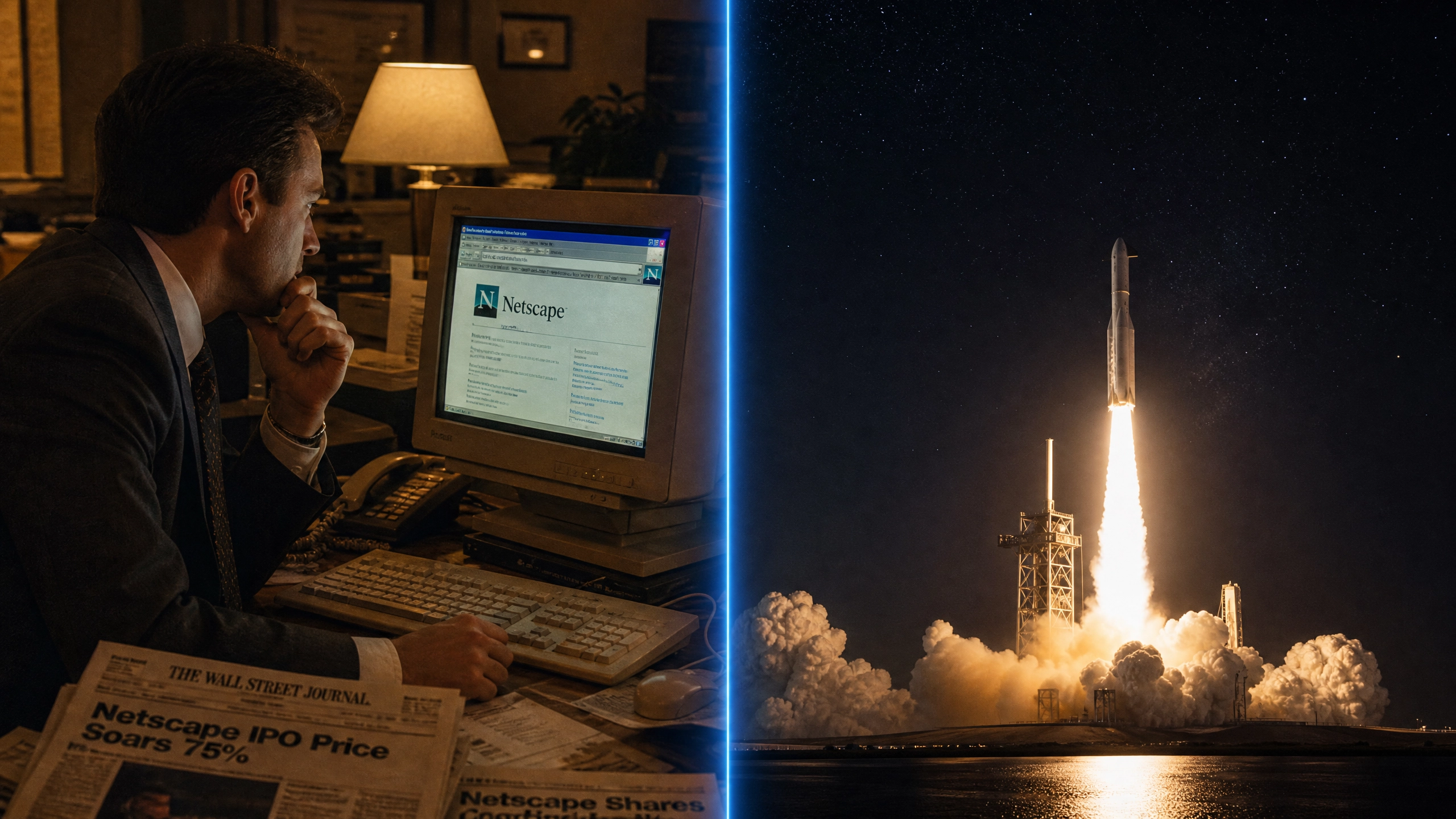
In 1995, the Netscape IPO turned a conviction held by a small number of evangelists into a consensus held by an entire civilization. The SpaceX IPO will do the same thing for the next chapter of human civilization.
It was 1995. I was sitting in my office when the CEO of my company called me down to his. I had been the internal evangelist — the person arguing, sometimes loudly, that the web was going to matter. That it wasn't a curiosity. That it was going to change everything.
Nobody wanted to hear it. We were a Windows company, backed by Microsoft founder Paul Allen. The internet, and specifically the web, was seen as a toy — something academics and hobbyists played with, not a serious business tool. The real world ran on Windows. The real money was in enterprise software. The web was a distraction.
Then Netscape went public.
On August 9, 1995, Netscape Communications Corporation — a company that had existed for less than two years and had never turned a profit — priced its IPO at $14 per share. By the end of the first day of trading, the stock had closed at $58.25. The company was worth $2.9 billion before it had earned a single dollar.
My CEO called me down not to tell me I had been right. He called me down because he had seen something in that moment that no spreadsheet could have shown him. He had seen that people — real people, investors, institutions, the public — were excited at a different level. Not about Netscape specifically. About what Netscape represented. He told me he wanted to embrace the web. That he saw it as the future.
He was not alone. Across corporate America, something shifted. CEOs who had known about the internet — who had nodded politely at briefings, who had let their IT departments experiment with it — suddenly understood that this was not a technology question. It was a direction question. And the direction had just been made unmistakably clear by the market.
Overnight, everyone wanted to be on the web. Everyone saw it as a common operating system — a layer that could sit between systems, between companies, between people. We didn't know how deep it would go. Nobody did. But we knew that was the direction. And the Netscape IPO was the moment that turned a conviction held by a small number of evangelists into a consensus held by an entire civilization.
Thirty-One Years Later
I believe we are living through that moment again. And the event that will mark it, when historians look back, is the SpaceX IPO.
The parallels are striking — and so are the differences.
In 1995, the technology was real but nascent. The web existed. Browsers existed. The infrastructure was fragile, the business models were unclear, and the timelines were uncertain. What Netscape's IPO did was not validate the technology. It validated the imagination. It told the world that this was the direction, and that the direction was worth betting on at scale.
Today, the technology is not nascent. It is here. Artificial intelligence is reshaping every industry it touches. Data centers are being built at a pace and scale that would have seemed absurd five years ago. Robotics is moving from factory floors to construction sites to surgical suites. And rockets — reusable, reliable, increasingly affordable rockets — have made the idea of operating beyond this planet not a fantasy but a logistics problem.
SpaceX has done something that no company in history has done: it has built the full stack for space. Launch vehicles. Crew transport. Satellite internet. Starship — a fully reusable heavy-lift rocket designed to carry humans and cargo to the Moon and Mars. The company does not depend on any other company to execute its mission. It is vertically integrated in a way that Boeing, Lockheed, and every legacy aerospace contractor is not, and cannot quickly become.
When SpaceX goes public, it will do what Netscape did in 1995. It will not merely raise capital. It will send a signal. It will tell every CEO, every board, every institutional investor, every government, and every ambitious young engineer that the direction has been set. That the question is no longer whether humanity will become a multi-planetary species, but how fast, and who will build the infrastructure that makes it possible.
The imagination of an entire generation will reorient. The conversations in boardrooms, in universities, in startup accelerators will shift. The questions will change from "how do we optimize what exists on Earth" to "what does it mean to build for a civilization that extends beyond it." We don't know how deep it will go. But we will know the direction. And the SpaceX IPO will be the moment that makes it undeniable.
One Critical Difference
There is one difference between 1995 and today that I think matters enormously, and it cuts in SpaceX's favor.
Netscape is gone.
It was not beaten by a better browser. It was absorbed and effectively destroyed by Microsoft's marketing machine — bundled out of existence by a company that controlled the operating system and used that control to make competition impossible. Netscape's technology was real. Its vision was correct. But it had a fatal vulnerability: it depended on a platform it did not own, and the owner of that platform decided it was a threat.
SpaceX has no equivalent vulnerability. It does not depend on anyone else's platform. It is the platform. The launch infrastructure, the orbital mechanics expertise, the manufacturing capability, the regulatory relationships, the reusability technology — all of it is proprietary, all of it took decades to build, and none of it can be replicated quickly by a competitor, a government, or a well-funded incumbent.
More importantly, SpaceX has no Microsoft. There is no dominant player in space infrastructure that controls the underlying layer and can bundle SpaceX out of existence. The legacy aerospace industry is not a threat — it is a cautionary tale. Blue Origin is a real competitor in ambition but not yet in execution at scale. No nation-state program moves fast enough to matter in the commercial timeframe.
SpaceX is not Netscape. It is closer to what Microsoft was in 1995 — the company that owns the platform everyone else will build on — except that it is also the company with the vision, the execution record, and the founder commitment to see the mission through.
What This Means
In 1995, the Netscape IPO did not make the web inevitable. The web was already inevitable. What it did was make the inevitability legible to the people who allocate capital, set strategy, and build companies. It compressed the timeline of belief.
The SpaceX IPO will do the same thing for the next chapter of human civilization.
The capability to move beyond this planet already exists. The rockets are real. The satellites are real. The data infrastructure is real. The AI systems that will be needed to operate at that scale are being built right now. What has been missing is the moment that makes the direction undeniable to the people who need to see it before they act.
That moment is coming.
Thirty-one years ago, I watched a CEO who had been skeptical of the web walk out of a meeting as a convert — not because the technology had changed, but because the market had spoken in a language he could not ignore. I expect to watch that happen again, at a scale and with a consequence that dwarfs what the internet produced.
The web connected the people of Earth. What comes next will take us beyond it.
Maury Blackman is the Managing Director of Pierpoint Ventures and the Founder of Insight Integrity Group. He writes on geopolitics, technology, and American competitiveness at mauryblackman.com.